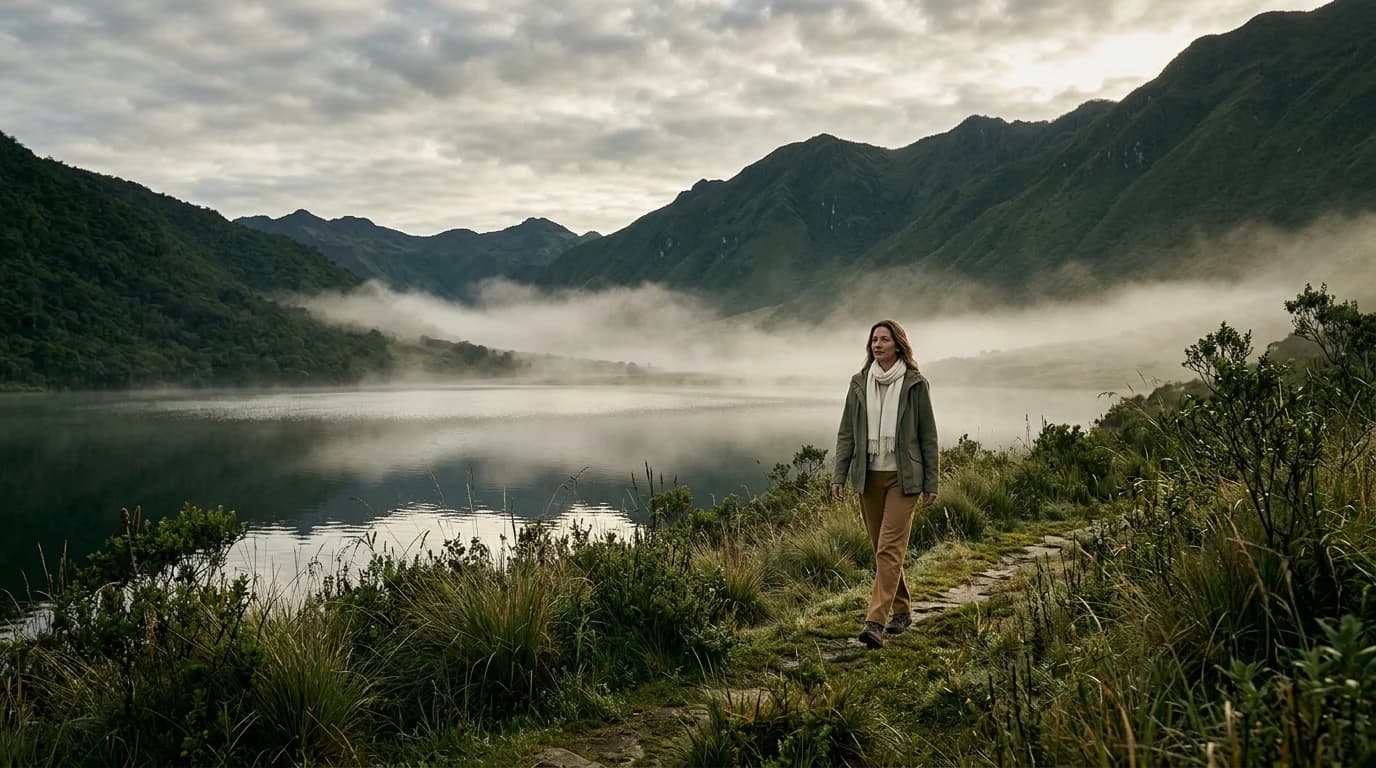
To walk with attention is to enter a conversation older than us—one shaped by water, roots, weather, and the people who learned to listen.
A landscape is never silent. Even where no voice can be heard, forms are speaking: the slope that gathers rain, the stone polished by passage, the plants that return after a long dry season.
We often move through these places looking for a destination. Yet another kind of journey begins when the destination loosens its hold and the path itself becomes a source of knowledge.
A territory is more than a setting
For many communities, territory is not an empty surface waiting to be used. It is a living network of relationships. Springs, paths, cultivated fields, winds, animals, and stories all take part in a shared continuity.
Memory lives there differently than it does in a book. It is carried through gesture, timing, naming, care, and the repeated act of returning. A trail can remember feet. A seed can remember a climate. A practice can remember the people who kept it alive.
The land does not ask us to interpret everything. It first asks us to remain present.Amaru Quispe
Three ways to enter a landscape with care
- 01
Slow down before trying to understand what you see.
- 02
Notice relationships: where water gathers, what offers shade, what grows together.
- 03
Leave space for local knowledge and for what cannot be translated immediately.

Remembering is also a responsibility
To say that a landscape remembers is not to romanticize it. Territory also records extraction, displacement, absence, and change. Listening includes the willingness to encounter those marks without turning away.
This is where ancestral knowledge and contemporary inquiry can meet with dignity. One offers continuity, relationship, and lived memory. The other can offer new forms of observation and shared evidence. Neither should erase the other.
The most useful question may not be what the landscape can give us, but what kind of relationship our presence is creating. Every visit, every harvest, every story, and every decision becomes part of what the place will carry forward.
Continue exploring this theme through our collection on Ancestral Knowledge, where memory, practice, and contemporary reflection meet.

The idea of a path remembering our steps stayed with me. It changes the way I think about returning to the same place.
1 repliesYes. Returning is never repetition when our attention has changed.
I appreciate that listening is presented as responsibility, not only as a beautiful idea. Relationship also asks something from us.